Uncategorized Archives - Page 5 of 6 - Atlas Foundation
Atlas Foundation

Share this:

Choosing a Foundation Repair Company

For many homeowners, the mere mention of the words “foundation problem” conjure up fearful thoughts or costly repairs and worse – fly-by-night charlatans who lack the skills, knowledge, and integrity to do the job right at a fair price.  These thoughts are often the result of nightmare stories told to them by someone who has had the misfortune to do business with a disreputable foundation repair company in the past. So, how do you ensure that the foundation repair company you hire won’t’ leave you with a depleted bank account and ongoing foundation problems? Here are some basic things every homeowner should do when choosing a foundation repair company.

Online Reviews
Start by asking for referrals from people you know and trust, like friends, family members and co-workers checking out the company’s references. If you don’t have any success there, a quick Google search will likely turn up dozens of options to choose from. In addition to customer testimonials on the company’s website, be sure to check out their online reviews on sites like Google, Yelp, the Better Business Bureau, Angie’s List, Good Contractors and others.

Check Referrals 
Before contracting with a foundation repair company you should also ask them to for a list of customers who have recently used their services. Any reputable company will be happy to provide you with a referral list. Be sure to actually contact these customers and ask them very specific questions about their experience with the company.

Licenses and Insurance 
Make sure the company you’re considering hiring to repair your foundation is licensed and insured. When it comes to licenses and insurance, don’t just take the contractor’s word for it. You should also verify the information with the appropriate state and local agencies.

Shop Around 
It’s a good idea to get written quotes from at least two contractors before making a final decision. Although you shouldn’t put off having foundation problems repaired, you also shouldn’t let yourself be pressured into committing to work with a foundation repair contractor who you haven’t fully vetted. High-pressure tactics to get you to sign a contract before you’re ready are an indication that the foundation repair company you’re considering hiring isn’t a wise choice.

Check the Warranty   
Find out if the foundation repair company warranties their work. Any foundation worth its salt will stand behind their work and will provide you with a written warranty. Remember, not all foundation repair warranties are the same. So be sure you read the fine print and make sure you understand all the terms and conditions of the warranty. And don’t be afraid to ask questions about anything you don’t fully understand.

Time in Business  
Finally, you should take into consideration how long the company has been in business. Although longevity isn’t a guarantee of quality, companies that don’t provide quality services don’t tend to stay in business long.

Following these simple tips will help ensure that the foundation repair company you choose has the knowledge, training and experience needed to ensure the repair will be done correctly and at a fair price.

If and when the time comes for you to choose a foundation repair company, we hope you’ll consider Atlas Foundation Company. Give us a call at 817-478-1181 to learn more about our warrantied foundation repair services or check out our reviews on Google, Angie’s List and Good Contractors and our Better Business Bureau A+ Rating.

Share this:

Springtime Foundation Maintenance Tips

With spring in the air, homeowners in the Dallas / Fort Worth area will soon be getting out to trim any overgrowth, clean gutters, inspect and clean the roof, and repaint their homes. Springtime is also the time to do a little foundation maintenance to fend off potential moisture problems and prevent costly foundation repairs.

Here are some simple things you can do to ensure your home’s foundation is ready for the springtime rains and summer heat that lies ahead:

  • Ensure good drainage around the house

Poor drainage around your home’s foundation can lead to problems. Ideally, the ground should slope approximately 6″ downhill away from the foundation over the first 10′ feet.

This article gives step-by-step instructions on how to measure the grade of the ground surrounding your foundation.

  • Use splash blocks to direct water away from your home’s foundation

As you inspect and clean the gutters, check to make sure that rainwater is being directed away from the foundation. Placing splash blocks at the point where downspouts meet the ground will keep water from pooling around the foundation.

  • Check for any plumbing issues

If you have leaky exterior faucets, they need to be repaired right away. Leaking faucets may not cause water pools right away, but they can keep the soil around the foundation continually wet. This weakens the foundation. Air conditioning drains can cause the same problem. So, make sure that AC drain pipes are installed properly and regularly cleaned to prevent overflow.

  • Use organic materials to improve soil structure around the home

Organic materials such as compost can improve both the nutrient content and structure of the soil near your house. This will help with drainage as the soil will be able to absorb and retain more water to the benefit of both your foundation and landscaping.

  • Plant ground cover to further improve water retention

During the warmer months, you can keep the soil adjacent to the foundation moist by planting ground cover. Ground cover is cost-efficient compared to other bedding plants because it requires little maintenance and doesn’t have to be replaced every season.

  • Choose bedding plants with low water needs

Finally, choose bedding plants that don’t require a lot of water. You’ll save on your water bills while keeping the soil around the foundation moist.

These simple springtime foundation maintenance activities are inexpensive and don’t require a lot of time, and they can save you a lot of aggravation and expense in the long run. If poor drainage is still a problem, you may need to consider having a French drain installed.

If you think you may have a foundation problem, call us at 817-478-1181 to schedule a no-cost, no-obligation estimate to repair your home’s foundation.

Share on Facebook
Share on Twitter

Share this:

Angie’s List Super Service Award

Award reflects company’s consistently high level of customer service 

Burleson, TX 2017 – Atlas Foundation Co, Inc. is proud to announce that it has earned the home service industry’s coveted Angie’s List Super Service Award (SSA). This award honors service professionals who have maintained exceptional service ratings and reviews on Angie’ s List in 2017.

“The service providers that receive our Angie’s List Super Service Award have demonstrated the level of excellence that members have come to expect,” said Angie’s List Founder Angie Hicks. “These pros have provided top-notch service to our members and absolutely deserve recognition for the exemplary customer service they exhibited in the past year.”

Angie’s List Super Service Award 2017 winners have met strict eligibility requirements, which include maintaining an ” A” rating in overall grade, recent grade, and review period grade. The SSA winners must be in good standing with Angie’s List, pass a background check, record a current trade license attestation and abide by Angie’s List operational guidelines.

Click here to learn more about the 2017 Angie’s List Super Service Award

Atlas Foundation Co, Inc has been listed on Angie’s List since 2012. This is the 2nd year Atlas Foundation Co, Inc. has received this honor.

Service company ratings are updated continua11y on Angie’ s List as new, verified consumer reviews are submitted. Companies are graded on an A through F scale in multiple fields ranging from price to professionalism to punctuality.

For over two decades Angie’s List has been a trusted name for connecting consumers to top-rated service professionals. Angie’s List provides unique tools and support designed to improve the local service experience for both consumers and service professionals.  Atlas Foundation Company, Inc has been family owned and operated in the DFW area since 1958.

Founded on principles of quality and integrity, Atlas offers a wide variety of services to repair slab and pier and beam foundations including concrete pressed pilings, steel pilings, interior leveling, and drainage. The repairs are backed by a True Limited Lifetime Warranty and three generations of knowledge to ensure your repairs are completed correctly and efficiently.

Contact: Atlas Foundation Co, Inc. (P) 817-478-1181
Website: www.atlasfoundationinc.com

Share this:

Protect Your Home’s Foundation During Drought

Protect Your Home’s Foundation During Drought

When we think about drought, most of us only imagine the impact it might have on crops and landscaping. What you may not know is that drought is just as bad for your home’s foundation. When soil around the foundation becomes extremely dry, it can contract, causing your home’s foundation to sink. In extremely dry seasons, soil can also settle suddenly, causing the foundation to settle and crack. A settled foundation can cost you tens of thousands of dollars to repair.

In recent years, much of the foundation repair in Fort Worth has been done in response to failures caused by drought.

One way to combat the impacts of drought on the home’s foundation is to take measures to prevent the soil from shrinking in the first place. The best way to do this is keeping soil around your home hydrated. Here are some simple things you can do to achieve this.

Plant shrubs and other plants around the foundation

Roots of plants help to hold soil particles together, keeping it from eroding away. During the dry season, plants also provide shade which slows moisture evaporation from the soil. Since you’ll be watering the plants regularly, you’ll also further reduce chances of foundation settling or cracking. Keep in mind that while planting shrubs and other garden plants near your home’s foundation can be beneficial, planting trees too close to your home can actually create problems for your foundation.

Water the foundation efficiently

Even in the absence of plants, you still need to regularly water your home’s foundation.  We have found that a drip irrigation system or soaker hose work best.

Consider mulching

Just like you would mulch your trees to slow down evaporation during the warm seasons, you should also mulch the soil around the foundation to keep it moist. Maintain a 2 to 4 inch layer of mulch around all shrubbery and flower beds surrounding the home. This will reduce the rate of evaporation from the soil below and allow what little water gets into the ground to stay there for a longer period of time.

Drip irrigate your lawn and foundation

Finally, you should water your foundation using a special hose known as a soaker hose. Soaker hoses attach to an outdoor faucet and have small holes that allow water to “sweat” through at a steady rate. The main benefit is that it economizes water usage by letting through very little water.

Lay the hose around the perimeter of your home, about 12 inches out from the foundation. Once the gap between the foundation and the surrounding soil has closed, reduce the amount of water being applied to the soil by reducing the pressure at the faucet.

Do you suspect that drought may have affected your home’s foundation? Call Atlas Foundation Company at 817-478-1181 to schedule a no-cost, no-obligation estimate today.

Share this:

Why Do I Need a Plumbing Test After a Foundation Repair?

One of the most common questions homeowners ask when having their foundation repaired is “Why do I need a plumbing test?”

A reputable foundation repair company will perform a hydrostatic plumbing test after any major slab foundation repairs are performed to ensure that there are no water leaks which could further damage your home.

Foundation problems can cause parts of your home and its plumbing to shift. Likewise, foundation repairs require that your home and in some cases its plumbing to be moved back into alignment. Both the problems and the repairs can cause plumbing pipes to leak or break. In some cases, a plumbing leak can actually be the reason foundation problems occurred in the first place. If a structural engineer oversees your repairs they will require a plumbing test be performed after repairs.

Why are post-foundation repair plumbing tests required?

Foundation repair contractors require plumbing tests to ensure that any pre-existing leaks or leaks caused during the repairs have been found and corrected for the following reasons: Leaking and broken water supply pipes and sewer lines can lead to additional foundation problems. They can also present a health risk to your family. Standing water can attract insects and lead to mold and mildew problems. And leaky and broken sewer lines can result in unpleasant odors and worse.

For all these reasons, foundation repair companies require that a plumbing test be done and that any problems found during the test be properly fixed before warrantying their work. Hydrostatic Plumbing Tests and Foundation Repair

What is a hydrostatic plumbing test?

A hydrostatic plumbing test is a very specific type of test that places the home’s entire sewage system under pressure and allows the plumbing contractor to identify even the smallest of problems.

During the test, a flexible, inflatable ball is placed in the home’s main sewer line cleanout and one toilet is removed. The ball is then inflated to the point where the sewer pipe is completely blocked, and the home’s sewer system is then filled with water up to the slab level. If the plumbing contractor isn’t able to raise the water level in the sewer system to slab level or if the water level reaches slab level but then drops within 15 minutes, leaks are present somewhere in the sanitary sewer system.

Most houses built after 1970 have a sewer cleanout located outside the home. If your home doesn’t have a cleanout, the plumbing contractor can remove a toilet located on your home’s lowest level and perform the test or a cleanout can be added.

We’re the Fort Worth Foundation Repair Experts

Don’t take chances with your home’s foundation. When it comes to foundation repairs, you can never be too careful. If you suspect your home’s foundation may be in need of repair, you should have it inspected by a reputable foundation repair contractor as soon as possible. Worried about the cost? That’s no reason to put off dealing with the issue. If your home does have a foundation problem, it will likely get worse and the cost of the repair will only increase as it does.

Want to learn more about plumbing tests? Give us a call at 817-478-1181. We’ll be happy to answer all your questions.

Think your foundation may be in need of repair? We offer Free Estimates and a Free Lifetime Structural Warranty on all pilings and piers we install. Call us today at 817-478-1181.

Share this:

Is My Foundation Covered by My Homeowners Insurance?

When you purchased that homeowners insurance policy, you probably had issues like wall and floor cracks in mind. You were hoping that if a disaster such as a flood or even a fire damaged your home, your policy would kick in and cover any damages.

Sorry to disappoint you, but that’s not always the case!

This is especially true of foundation repair. When your foundation is damaged, your homeowner’s insurance policy might not help much.

Most homeowner’s insurance companies deliberately exclude foundation repair from their policies for two reasons.

Most foundation damages are caused by construction defects

Insurance companies are aware that most foundation damages, particularly in older homes, are caused by poor design and engineering. Many older homes were not built to withstand movements in the soil which is a common problem here in the Fort Worth area. Thus, most foundation damages are likely to be a result of construction flaws rather than disasters. Homeowner’s policies typically don’t cover construction defects.

Homeowners insurance does not cover maintenance and repair

This is a little like expecting your auto insurance provider to cover worn tires and belts. Auto policies cover disasters such as collisions. Tires are for you to maintain and replace as necessary. The same applies to your home’s foundations. You are solely responsible for maintaining you foundation.

Certain foundation damages might be covered

If your home’s foundation is damaged, your homeowner’s insurance may or may not cover the repair. Depending on your insurance provider, and policy you may be covered for:

  • Earthquake damages – Damages caused by earthquakes are generally covered, though not by all insurance providers. Check with your insurance company to find out about your particular policy.
  • Damages caused by flooding – Your policy may also cover damages resulting from floods, especially if you purchased additional coverage.
  • Water damage from plumbing failures – If there is a problem with your plumbing and the resulting leak causes foundation damage, some policies might cover the repairs.


Measures you can take to protect yourself

Start by demanding a foundation warranty when purchasing a new home. These types of warranties typically cover unforeseen foundation problems for up to ten years but in some cases, they can be extended when the original coverage period ends.

If your foundation requires repairs after the original warranty has ended, you should be sure to hire a foundation repair company that offers a warranty on their work. Here at Atlas Foundation Company, we offer a lifetime, tranferable warranty on all of our foundation repairs.

Secondly, you may want to consider purchasing supplemental coverage specifically for the foundation. Supplemental coverage will protect you in the event your foundation suffers damages that are not covered in your original homeowners policy.

Lastly and most importantly, take the necessary steps to prevent foundation damage by addressing any warning signs at an early stage. If you think your home foundation may have problems, you should have it inspected by a reputable foundation repair contractor to prevent the problem from getting any worse. Call Atlas Foundation Company at (817) 478-1181 to schedule a no-obligation estimate to repair your home’s foundation.

Share this:

Foundation Maintenance Tips for the DFW Rainy Season

Foundation Maintenance During the Rainy Season in DFW

www.rssweather.com

In many parts of the country, April marks the beginning of the rainy season; hence the saying, “April showers bring May flowers.”  But here in the Dallas/Fort Worth, May is historically our rainiest month.  And while we need the rain to get us through the hot, dry month’s that follow, it can also wreak havoc on your home’s foundation unless it’s handled properly.

Proper drainage is essential in order to protect your home’s foundation.  Over time, standing water can seep into it and weaken it.  Here are some simple ways to make sure your foundation is ready for the DFW rainy season.

  • Check for depressions in the ground adjacent the foundation and fill them in topsoil to ensure that water drains away from your home. Most foundation repair contractors agree that a slope of 5% (six inches over the first 10 feet) is needed to prevent pooling.
  • Re-seed or re-sod bare patches in your lawn near your home.
  • Repair leaky gutters and make sure your downspouts and extensions are properly fitted and positioned to evacuate rainwater away from the house.
  • Remove debris from gutters and downspouts to keep them from backing up and overflowing onto the ground near your home.
  • Check your driveway, patio, and walkways for cracks. Small cracks should be filled with concrete or asphalt to keep rainwater from seeping into the void and raising the surrounding concrete which can worsen the crack.
  • In some cases, you may want to consider installing French drains in low-lying areas near your home’s foundation and concrete patio to prevent pooling.
  • Make sure your foundation isn’t being threatened by tree roots. According to the North Carolina State University College of Agriculture and Life Sciences website,  “One large tree can lift up to 100 gallons of water out of the ground.”  That can be a benefit during the rainy months.  But root systems that grow too close to your home can also grow beneath its foundation, driveway, sidewalks, and patio; exerting tremendous upward pressure on these structures.

To have a healthy foundation, you need to maintain a consistent soil moisture content level.  This can be a real challenge here in the Dallas/Fort Worth area, but these simple maintenance activities can help.

Do you think you may already have foundation problems? Now is the time to have it checked out.  Call Atlas Foundation at 817-478-1181 to schedule a free, no-obligation estimate.

Share this:

How to Evaluate Your Concrete Slab Foundation

Evaluate Your Concrete Slab Foundation

The concrete slab foundation is a vital component of your home’s structure. When it gets damaged, it’s only be a matter of time before the entire building is affected. So, it’s important to evaluate your foundation on a regular basis to identify potential problems and call in a
foundation repair specialist to advise on what steps you need to take to remedy the situation.

Common Signs of Concrete Slab Foundation Problems

Cracks in the foundation:

This is usually one of the very first signs that a foundation is under stress. When external and internal elements force the foundation to shrink and expand repeatedly, cracks will form within the foundation concrete. However, not all cracks are an indication of a foundation problem so have a foundation repair professional look at your cracks to determine if they should be a cause for concern.

Separation around doors:

A shift in the foundation creates stress on walls and door joints which often leads to separation and sometimes even cracks. The simplest way to tell if there has been separation is to try closing and then opening any of your doors. If doors that initially opened smoothly now need to be forced into the frame, or if some doors are refusing to stay open, then there has been separation.

Sticky or loose windows:

Similar to doors, if your foundation has shifted, your windows are likely show all kinds of problems. Depending on the direction in which the foundation has shifted, a window might refuse to close unless a great deal of force is applied, or it could refuse to stay open. A stiff or loose window is a sign of trouble in the home’s foundation.

Cracks on walls:

Finally, issues with the foundation can also cause cracks in the walls, both internally and externally. Inside the house, pay particular attention to the joints where walls meet the ceiling, doors, or other walls. Externally, concentrate on joints where walls meet other walls, windows, and doors. If there is pronounced cracking, it could be a sign of foundation shifting.

If you live in the Greater Fort Worth area, and suspect there may be a problem with your home’s foundation,
contact us and schedule a free estimate.

Share this:

Mud Jacking Explained

Mud Jacking Explained

Mud jacking is a commonly used method of foundation repair in Fort Worth and the greater DFW area but many people have never heard of it. Most homeowners don’t give much thought to their concrete driveways, walkways, porches or patios unless the concrete begins to sink or crack. This can negatively impact your home’s curb appeal and can also be a safety hazard for your family and guests.


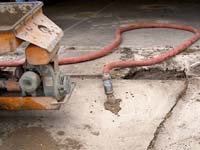
Fortunately, it is possible to easily and quickly repair sunken concrete using a process called mud jacking, also referred to as slab jacking. Simply put, it is the process of raising sunken concrete back to its original level using a mixture of sand, soil, water, and cement. A mixture of the four materials is mixed to form what foundation repair pros call “mud.” The mud is pumped beneath the sunken portion of the concrete to lift it. The mixture cures to form a solid, stable foundation that stabilizes the slab back in its original position.

Common Mud Jacking Applications

Filling voids under a slab foundation, concrete patio or driveway.  A majority of concrete slab problems occur when the perimeter of the foundation settles. To correct the issue, a foundation professional will level settled sections of the foundation with push piers. The piers are installed under the perimeter grade beam and the foundation is raised, leaving a void under the slab.


Mud jacking is then used to fill the void by drilling 2-inch holes through the perimeter grade beam and pumping the mud into the void. Raising interior floors The mud jacking technique can also be used to raise a settled interior portion of a slab. The same process is followed. First, 2-inch holes are drilled through the slab in the areas that have settled. Then, a mixture of sand, water, soil, and cement is pumped underneath the concrete slab, lifting it back to its original position.


Those are just two of the most common applications. Mud jacking can be used in several other situations where a settled or sunken portion of concrete needs to be lifted.


Mud jacking advantages

  • It can be accomplished in any kind of weather. Even in freezing winters, you can use mud jacking without compromising the strength of your slabs. It is a quick process compared to traditional rip-and-replace foundation repair techniques.
  • Depending on the project, mud jacking can often be completed in just a few hours.
  • The process allows for almost immediate use. Within 24 to 48 hours, the mud will have cured and will be ready to bear any load.

All things considered, mud jacking is much more cost effective than replacing the defective concrete. Need more information about mud jacking? Give us a call at (817) 478-1181 to learn more, or to schedule a no cost, no obligation estimate.

Share this:

How Your Home Foundation Ages

Home Foundation Aging

Home foundation aging is inevitable, but certain factors can speed up the process to the point that it compromises the integrity of the entire structure.

Home foundation aging basically results over time from changing conditions of the soil around your home and in some cases from construction and plumbing problems and the presence of large trees near your home.

As the soil around your home expands it absorbs water and contracts as it dries out, causing your foundation to move, settle, and in some cases crack.

The rate of foundation aging can be worsened by several factors.

Common Causes of Home Foundation Aging

  • Snow and Ice: After a heavy snow fall, the accumulated snow will melt, causing heavy flooding and pooling. This can result in water seeping into the foundation. When this happens repeatedly, the foundation will become weaker and weaker and may soon settle.
  • Drought: Drought combined with high heat in the summertime is a significant aging factor for home foundations. In severe drought conditions, moisture is removed from the soil causing the soil around your home to shrink and pull away from the foundation. Often, this results in a gap between the soil and your foundation, allowing for foundation movement. From there it doesn’t take long before the foundation begins to shift.
  • Earthquakes: Although large earthquakes don’t happen frequently in the Fort Worth area, the DFW area is subject to seismic activity and over time it too can have an impact on foundation aging. When the ground shakes, the foundation is the most affected part of the home. Even minor tremors can cause small cracks in the foundation. Eventually, these small cracks can become bigger and cause shifting.
  • Plumbing leaks: When water leaks from one of your pipes, it will be absorbed by the soil adjacent to your foundation. Initially, this may not pose a problem. But after several significant leaks over an extended period of time, the foundation may begin to feel the impact. The soil will expand and push your foundation upwards, a process known as upheaval.
  • Poor drainage: Depending on where you live in the Dallas / Fort Worth area, poor drainage can be a Where there is poor drainage, foundation aging occurs at an unprecedented rate. This is because water will pool around the home and seep into the foundation. To avoid this, ensure that all rain water is directed away from the home. Install downspouts to direct water from the roof. Then, create drainage channels to direct this water away from the foundation.
  • Large trees next to your home: Having large trees next to your home comes with many problems. The extending roots will absorb all the water needed to keep the soil moist. The roots can also grow through cracks in the foundation or even push the foundation. In short, avoid having large trees too close to your house.
  • Faulty construction: Finally, inferior foundation construction can also accelerate foundation aging. Low-quality steel and inferior concrete can contribute to movement in the foundation resulting in fast settling.

When two or more of these factors combine the foundation aging process accelerates, usually requiring repair of some sort.  The most common types of foundation repair for homes in the Fort Worth area include:

If you feel that your foundation may be in need of repair due to any of the aging factors listed above, give us a call at 817-478-1181 and schedule a no-cost, no-obligation estimate from one of our experienced foundation repair specialists.