


Why Is the Soil Pulling Away From My Foundation?
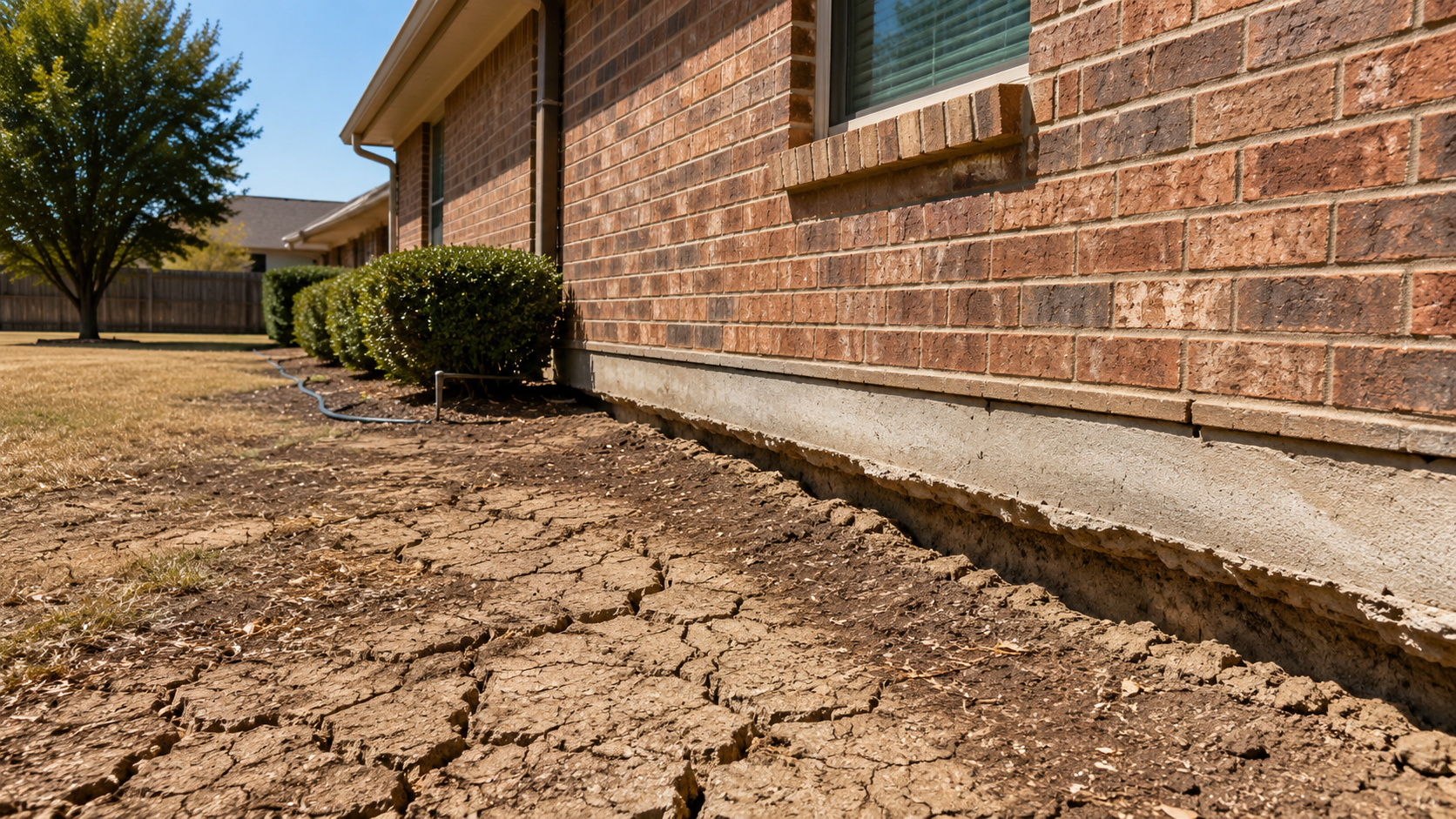
If you walk around your house during a North Texas summer and notice a gap between the soil and the edge of your foundation, it can look alarming. In many cases, though, the explanation is relatively straightforward: clay-rich soil has lost moisture, contracted, and physically pulled away from the slab.
That gap does not automatically mean your foundation is damaged. It does tell you that the moisture conditions around your home have changed, and because the same soil supports your foundation, it is worth paying attention to what happens next.
For some homeowners, the answer is better soil-moisture management. For others, the gap appears alongside sticking doors, masonry cracks, drywall cracks, uneven floors, or other signs that warrant a professional foundation evaluation. Knowing which situation you have is the important part.
Why Does Soil Pull Away From a Foundation?
Much of Dallas-Fort Worth has clay-rich soil, and clay changes volume as its moisture content changes. When it absorbs moisture, it expands. During prolonged hot and dry weather, it loses moisture and contracts.
That contraction can produce the familiar cracks you see across a dried-out yard, but it can also cause the soil immediately beside your home to pull away from the concrete foundation. Depending on shade, drainage, trees, landscaping, irrigation, and soil conditions, one side of the house may show considerably more separation than another.
The visible gap is therefore a symptom of changing soil conditions, not a diagnosis of foundation damage.
Does Soil Pulling Away Mean Your Foundation Is Damaged?
Not necessarily. Dry soil can shrink substantially without the foundation itself experiencing problematic movement.
What matters more is whether the house is showing other changes at the same time. Sticking doors, windows that suddenly become difficult to operate, new diagonal drywall cracks, widening brick or mortar cracks, separation around trim, and noticeable floor changes can make the situation more significant.
If all you see is dry, contracted soil, moisture management may be the logical place to start. If the house itself appears to be changing, guessing becomes less useful.
Atlas can evaluate the foundation and help determine whether you are looking at ordinary seasonal soil shrinkage or signs of actual foundation movement. If you are already seeing several structural symptoms, book a free Atlas foundation evaluation rather than assuming watering alone will solve the problem.
Why North Texas Soil Can Change So Dramatically
A North Texas summer can pull moisture from the ground for weeks or months. Heat increases evaporation while grass, landscaping, and mature trees continue drawing water through their root systems. Roof overhangs may keep rainfall from reaching the soil beside the house, while patios and driveways create completely different moisture conditions only a few feet away.
The result is rarely perfectly uniform. One portion of the soil supporting a home can remain relatively stable while another becomes considerably drier. That distinction matters because foundations are affected less by the simple fact that soil changes than by uneven soil conditions around different portions of the structure.
Keeping the surrounding soil reasonably consistent is one reason foundation watering is common in North Texas.
Should You Fill the Gap With Dirt?
It is tempting. There is a hole, so put dirt in the hole.
But if the original soil contracted because it lost moisture, adding more dry soil to the opening does not address why the gap appeared. When moisture eventually returns, the original clay can expand again.
The more useful question is whether the surrounding soil needs gradual moisture restoration. The same logic applies to water. You do not want to treat the visible crack as a channel that simply needs to be filled.
Should You Pour Water Directly Into the Gap?
No. Dumping water straight into the opening concentrates moisture against one narrow portion of the foundation instead of gradually conditioning the broader surrounding soil.
Foundation watering works better when moisture enters the soil slowly and consistently. The objective is penetration beneath the surface, not merely making the first inch of dirt look wet.
This distinction matters because a homeowner can spend ten minutes spraying dry dirt with a garden hose and walk away thinking the foundation has been watered. In reality, the surface may be wet while the soil beneath it remains extremely dry.
Can You Water the Foundation Yourself?
Yes. A homeowner can use a conventional garden hose or soaker hose to manage soil moisture around a foundation. The water should generally be applied to the soil beside the foundation rather than blasted directly against the concrete, and it should be applied slowly enough that it penetrates instead of immediately running away.
The difficult part is consistency. You have to work around the relevant perimeter, account for shaded and sunny areas, watch for runoff, respond to rainfall, avoid creating muddy sections, and make sure you are doing more than wetting the surface. If you are hand watering with a hose, that also means moving it repeatedly and giving each area enough time to absorb moisture.
It works.
It can also become a part-time job in hydrology.
Why Atlas Uses a Porous Foundation Watering System
Atlas offers a Foundation Watering Program designed to take much of that manual work out of the process.
Rather than relying on someone to stand outside moving a garden hose from section to section, a porous watering hose distributes water slowly along the foundation perimeter. Slow application gives water time to penetrate the surrounding soil instead of simply soaking the surface or running down the driveway.
During sufficiently hot and dry conditions, an Atlas watering system may operate for periods around two hours every two days, although the correct schedule depends on the property, soil, rainfall, drainage, landscaping, and other conditions. The important thing is not blindly following a timer. It is producing slow, reasonably even moisture around the foundation without turning the yard into a swamp.
If you are already looking at a widening band of dry soil around the house and thinking you would rather not spend your evenings relocating a garden hose, Atlas’s foundation watering program is designed for exactly that problem.
Will Watering Make the Gap Close?
It may. Dry clay can expand as moisture gradually returns, so the separation between the soil and foundation may become smaller.
That does not mean you should try to force the gap shut with a huge dose of water. Rapidly changing the moisture condition in one location is not the goal. Think in terms of maintaining the surrounding soil rather than repairing a visible crack in the dirt.
The gap is what you can see. The moisture condition is what you are actually managing.
Can You Overwater a Foundation?
Yes, which is another reason “just add water” is not much of a maintenance plan. Too much water can contribute to standing water, erosion, poor drainage, soggy landscaping, and highly uneven soil moisture.
If one side of the house receives substantially more water than another, you may simply be replacing one moisture imbalance with another. Good foundation watering is therefore neither drought nor deluge. The target is relatively consistent soil moisture appropriate for the property and weather conditions.
If water is repeatedly pooling near the house, running toward the foundation, or eroding soil around one section, the problem may involve drainage rather than watering. Atlas also provides drainage services to help manage how water moves around the property.
What If the Gap Is Only on One Side of the House?
That is worth investigating. One side may receive more afternoon sun, sit near large trees, receive less irrigation, or be protected from rainfall by a roof overhang. Another side may receive concentrated runoff from gutters or downspouts.
Walk the property and compare conditions rather than treating the house as though every side experiences the same environment. If one area is consistently much wetter or drier than another, that difference may explain why the soil is behaving differently there.
If drainage is contributing to the imbalance, correcting how water moves around the property may be more useful than simply adding more irrigation.
What If You Also Have Sticking Doors or Cracks?
That changes the conversation.
A gap in dry soil alone does not establish that your foundation needs repair. A soil gap combined with widening masonry cracks, several sticking doors, changing window openings, significant drywall cracks, or noticeable floor movement deserves closer attention.
Those are the circumstances where a professional evaluation becomes more useful than experimenting with additional water and hoping for the best. Atlas can inspect the foundation, look at the pattern of symptoms, and help determine whether the problem is seasonal soil contraction, drainage, moisture management, plumbing, or actual foundation movement.
You can also review Atlas’s guide to the signs of foundation problems before deciding whether an evaluation makes sense.
Could Plumbing Be Affecting the Soil?
Yes. A leak beneath or near a slab can introduce substantial moisture into soil that would otherwise be dry, creating very different conditions beneath one portion of the house compared with another.
Foundation movement can also place stress on plumbing, which is why foundation and plumbing symptoms occasionally appear together. If there is reason to suspect an under-slab plumbing problem, testing may be more appropriate than simply increasing foundation watering.
Atlas also provides plumbing services when the evidence points toward a leak or other under-slab issue. The goal is to identify the actual cause before spending money correcting the wrong problem.
What Should You Do If the Soil Is Pulling Away Right Now?
Start with a walk around the property. Compare the soil on different sides of the house, check gutters and downspouts, look for erosion or standing water, notice mature trees and landscaping, and see whether the ground is cracked or extremely hard.
Then inspect the house itself. If you are seeing dry soil but no meaningful structural symptoms, begin thinking about consistent foundation moisture management. You can do it manually if you are willing to devote the time to slow, even watering.
If you would rather have a system designed to distribute water gradually around the foundation, talk to Atlas about the Foundation Watering Program.
If the soil gap is accompanied by structural symptoms, skip the guessing and schedule a free foundation evaluation.
The Gap Is a Clue, Not a Diagnosis
Soil pulling away from a foundation is common during prolonged North Texas heat because clay contracts as it loses moisture. The gap can look dramatic while the foundation itself remains perfectly serviceable.
But it is still useful information. It tells you that the soil surrounding the home has become dry enough to change volume, and that is a good reason to look at moisture consistency, drainage, and the condition of the house itself.
If your problem is mainly dry soil, Atlas can help take foundation watering off your personal chore list with a system designed for slow, consistent moisture delivery. If you are seeing cracks, sticking doors, uneven floors, or other signs of movement, Atlas can evaluate the foundation and help determine whether something more significant is happening.
Dry soil and tired of hand watering? Learn more about the Atlas Foundation Watering Program.
Seeing cracks, sticking doors, uneven floors, or other movement? Book a free Atlas foundation evaluation.
Soil and Foundation FAQs
Why is the dirt pulling away from my foundation?
During hot, dry weather, North Texas clay soil can lose moisture and contract. As it shrinks, a visible gap can develop between the soil and foundation.
Does soil pulling away mean my foundation is damaged?
No. A soil gap by itself does not prove foundation damage. It becomes more significant when accompanied by structural symptoms such as sticking doors, worsening cracks, difficult windows, or noticeable floor changes.
Should I fill the gap between the soil and foundation with dirt?
Usually not as the first response. If soil contraction caused the opening, adding dirt does not correct the underlying moisture condition.
Should I pour water directly into the gap?
No. Water the surrounding soil gradually rather than dumping water directly into the opening.
Can I water my foundation myself?
Yes. DIY watering can work if water is applied slowly, evenly, and consistently around the relevant perimeter. The challenge is providing enough time for deeper penetration and maintaining the routine as weather conditions change.
Is a foundation watering system easier than hand watering?
For many homeowners, yes. A porous watering system can distribute water slowly around a larger portion of the foundation without requiring someone to continually move a garden hose.
Can foundation watering repair existing foundation damage?
No. Foundation watering is soil-moisture management. Existing structural movement should be evaluated separately.
When should I call Atlas?
If the main issue is dry soil and inconsistent moisture, contact Atlas about the Foundation Watering Program. If the soil separation appears alongside cracking, sticking doors, uneven floors, or other structural symptoms, schedule a free foundation evaluation so the underlying cause can be identified.