
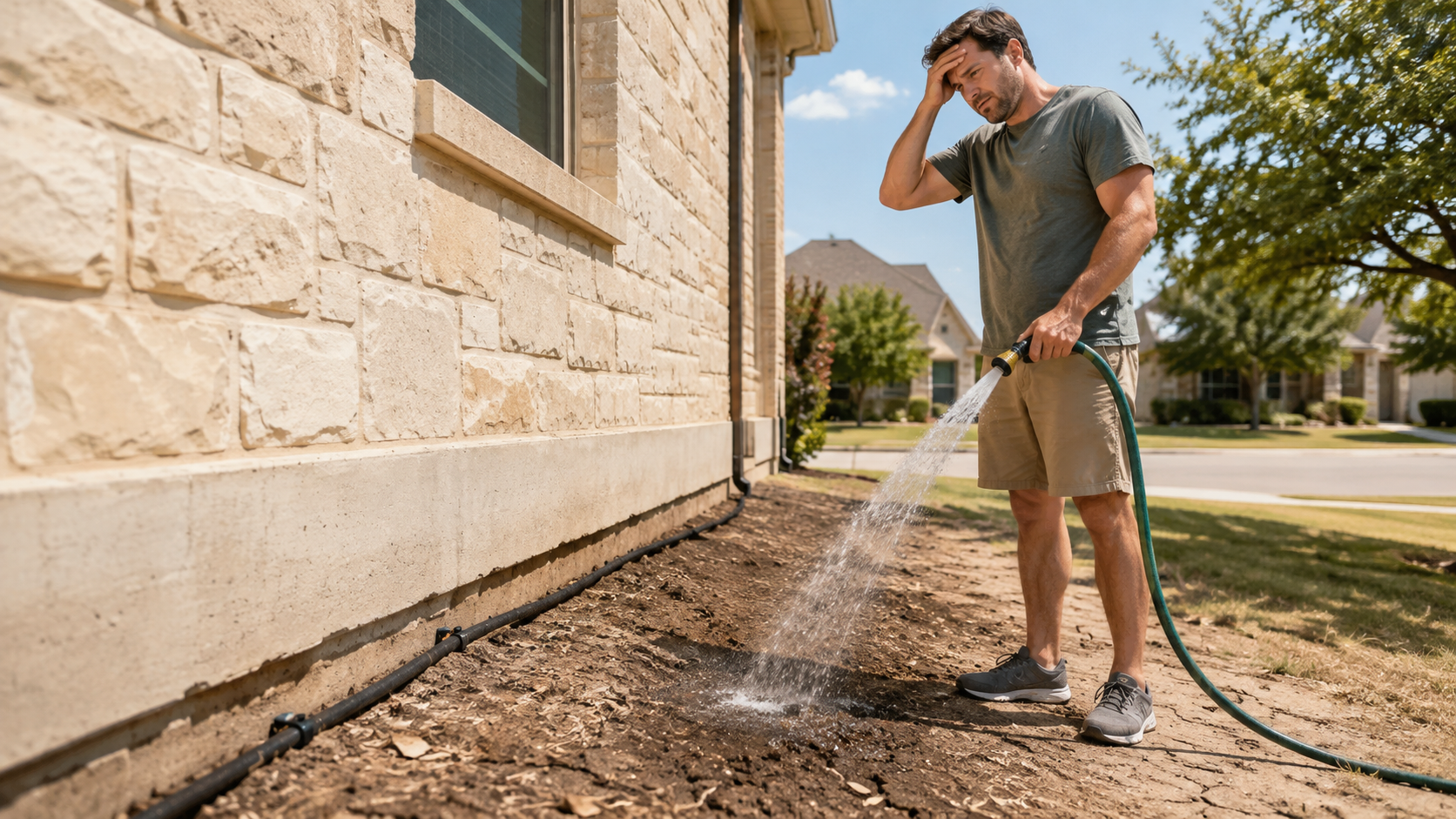


DIY Foundation Watering: Yes, You Can Do It by Hand. Here’s Why You May Not Want To.
If the soil around your North Texas home is cracking, shrinking, or pulling away from the foundation, reaching for the garden hose is a reasonable first thought. And yes, you can water the soil around a foundation by hand.
The catch is that proper foundation watering is not the same as spraying the flower beds or making the top inch of dirt look damp. The goal is to maintain reasonably consistent moisture in the soil surrounding the foundation, which means applying water slowly enough and long enough for it to penetrate rather than simply running across the surface.
Doing that yourself is entirely possible. Doing it consistently around an entire house through a North Texas summer is where the garden hose begins negotiating for overtime.
If you would rather automate much of that work, Atlas offers a Foundation Watering Program designed to distribute water slowly and consistently around the foundation perimeter.
Does Soil Pulling Away From the Foundation Mean You Have Foundation Damage?
Not necessarily. During prolonged hot and dry weather, clay-rich soil can lose moisture, shrink, and pull away from the edge of a foundation. The resulting gap may look dramatic without proving that the foundation itself has failed.
What the gap does tell you is that the surrounding soil has become dry enough to contract. Because clay can expand as it absorbs moisture and contract as it dries, large swings in moisture conditions can change the soil supporting different portions of the house.
Foundation watering is therefore a moisture-management strategy, not a structural repair. If the house is already showing significant cracks, multiple sticking doors, uneven floors, separated trim, or other signs of movement, adding more water should not substitute for determining what is actually happening.
If those symptoms are already present, schedule a free Atlas foundation evaluation before assuming the solution is simply more watering.
Can You Water a Foundation With a Normal Garden Hose?
Yes. You do not need specialized equipment to begin managing soil moisture around a foundation.
The important distinction is that you are watering the soil, not the concrete. Holding a hose against the side of the house for five minutes may make the ground look wet, but surface moisture tells you very little about what is happening several inches below.
North Texas soil can darken almost immediately when water hits it while remaining extremely dry underneath. Effective foundation watering requires slow application and enough time for moisture to work into the soil.
That is simple in principle.
It becomes considerably less simple when you have to do it around the whole house.
How Do You DIY Foundation Watering?
Water the Soil Beside the Foundation, Not the Concrete
Apply water to the soil near the foundation rather than blasting the slab or foundation wall directly. A common starting point is roughly 12 to 24 inches away from the foundation, although landscaping, drainage, patios, slopes, soil conditions, and the particular house can affect placement.
Avoid high-pressure spraying. The objective is to introduce moisture into the surrounding soil, not erode it, wash it away, or create standing water immediately beside the structure.
Use a Slow Flow
Foundation watering works best when water enters the soil gradually. A gentle hose flow, slow trickle, porous hose, or soaker-style hose gives the ground time to absorb moisture instead of sending most of the water down the driveway.
If you turn on the hose and immediately see water racing across the yard, you are mostly watering the storm drain.
Slow it down.
Give the Water Time to Penetrate
This is where DIY foundation watering starts becoming inconvenient. You cannot walk around the house spraying every section for thirty seconds and expect meaningful moisture penetration.
With one ordinary hose, you may need to position it along one section of the house, give that area time to absorb water, move the hose farther along the perimeter, wait again, and continue until you have covered the relevant portions of the foundation.
Then you have to do it again when conditions call for another watering.
The actual technique is not particularly difficult. The commitment is remembering the routine and repeating it consistently enough for it to matter.
Water Around the Perimeter as Evenly as Practical
Watering one side heavily while another remains extremely dry defeats much of the purpose. Soil conditions will never be perfectly uniform, but foundation watering is intended to reduce unnecessary extremes.
That means paying attention to areas receiving full afternoon sun, shaded areas, roof overhangs, landscaping, mature trees, slopes, driveways, patios, drainage patterns, and sections of soil that dry noticeably faster than others.
At this point, your simple garden-hose project has become a small irrigation-management program.
This is exactly the job a dedicated Atlas foundation watering system is designed to make easier.
How Often Should You Water Your Foundation in Texas?
There is no universal schedule that works for every North Texas property. Temperature, rainfall, soil composition, shade, drainage, landscaping, water flow, and the home itself all affect how quickly surrounding soil dries.
During prolonged hot and dry periods, foundation watering may be needed several times per week. Atlas uses a slow-saturation approach with porous watering hose, and under sufficiently dry conditions watering periods may run around two hours every two days. That should not be treated as a universal prescription for every home.
The principle matters more than blindly copying a timer: slow, regular moisture penetration is more useful than occasionally soaking the surface.
Rainfall also matters. If North Texas receives substantial rain, watering should be reduced or stopped accordingly. The objective is reasonably consistent moisture, not maximum moisture and certainly not a swamp.
Why Doesn’t Simply Spraying Dry Soil Work?
Because wet-looking dirt and adequately moistened soil are not the same thing.
Water can make sun-baked soil turn dark within seconds. That does not mean the moisture has penetrated deeply enough to affect the larger body of soil surrounding the foundation. A short burst from the hose can produce a wonderfully convincing visual result while accomplishing very little below the surface.
Slow-delivery methods such as porous hose help because water is released gradually along a larger area, giving it more opportunity to soak downward rather than immediately becoming runoff.
Foundation watering is about what is happening inside the soil, not what the dirt looks like from the patio.
How Can You Tell Whether Water Is Penetrating the Soil?
A simple homeowner check is to use a long screwdriver or similar probe after watering. Push it into the soil near the watered area. Extremely hard soil that resists penetration may still be quite dry, while soil that allows easier penetration without becoming muddy suggests that moisture has reached farther beneath the surface.
This is not an engineering test or a substitute for a professional assessment. It is simply a practical reminder that the appearance of the surface does not tell the whole story.
If you are repeatedly watering but the soil remains extremely hard, cracks continue developing, or one portion of the property behaves very differently from another, there may be more going on than your watering routine can address.
Should You Pour Water Into the Gap Between the Soil and Foundation?
No. If dry clay has contracted and created a visible opening beside the foundation, resist the temptation to put the hose into the gap and fill it like a trench.
The goal is to restore moisture gradually to the surrounding soil, not concentrate a large amount of water in one narrow opening. Watering the broader soil area slowly encourages more consistent moisture conditions and reduces the likelihood of simply creating a wet pocket beside otherwise dry ground.
The gap is a symptom of dry soil. It is not a tiny reservoir waiting to be filled.
Can You Overwater Around a Foundation?
Yes. More water is not automatically better.
Excessive watering can create muddy soil, runoff, erosion, standing water, poor drainage conditions, and large differences in moisture between different portions of the property. If water repeatedly collects beside one side of the house, the solution may involve drainage rather than more foundation watering.
Atlas also provides foundation drainage services for properties where runoff, grading, downspouts, or standing water are contributing to uneven moisture conditions around the home.
The goal of foundation watering is consistency. You are trying to avoid extremes in either direction.
Is DIY Foundation Watering Cheaper?
Almost certainly.
If you already own a garden hose, the equipment cost can be close to zero. What you are spending instead is time.
You need to remember the watering schedule, position the hose, wait for the soil to absorb moisture, move the hose, wait again, work your way around the house, compensate for areas that dry faster, account for rainfall, and repeat the process throughout prolonged hot and dry weather.
You have saved money.
You have also acquired a part-time job in hydrology.
For someone who enjoys working around the yard and is willing to maintain the routine, that may be perfectly acceptable. For everyone else, convenience becomes part of the calculation.
Why Use a Porous Foundation Watering System?
A porous foundation watering system distributes water slowly along a much larger portion of the foundation perimeter at the same time. Instead of saturating one small patch, moving a hose, waiting, and repeating the process, the system can deliver moisture gradually across many feet of surrounding soil.
That addresses the three biggest frustrations with hand watering: consistency, penetration, and time.
Slow watering gives the soil more time to absorb moisture. More of the perimeter can receive water at approximately the same time. And the homeowner does not need to spend an evening relocating a garden hose every few minutes.
A watering routine only helps if somebody actually keeps doing it.
Atlas’s Foundation Watering Program is intended for homeowners who want the benefits of more consistent soil-moisture management without personally supervising every watering cycle.
Does Foundation Watering Prevent Foundation Problems?
Foundation watering should not be treated as a guarantee against foundation movement. Many factors influence a foundation, including soil conditions, drainage, tree roots, plumbing leaks, construction, grading, drought, rainfall, and previous structural movement.
Watering is one tool for managing the soil environment around the foundation. It cannot repair structural damage that already exists.
That distinction is important because the homeowner who sees nothing more than dry, shrinking soil is in a different situation from the homeowner who has three sticking doors, widening masonry cracks, diagonal drywall cracks, and an increasingly uneven floor.
The first homeowner may need better moisture management.
The second homeowner needs to know whether the foundation is moving.
If your home is already showing several signs of foundation problems, book a free Atlas foundation evaluation rather than trying to solve structural symptoms with a garden hose.
So Should You DIY Your Foundation Watering?
You can.
If you enjoy yard maintenance, have the time to monitor conditions, remember the schedule, and are willing to work around the entire home, manual foundation watering can be perfectly practical. Water slowly, focus on the surrounding soil rather than the concrete, give moisture time to penetrate, distribute it as evenly as practical, and adjust for rainfall.
The complication is not understanding those instructions.
It is still doing them several weeks later.
If you would rather turn on a system that distributes water gradually along the foundation perimeter, talk to Atlas about a foundation watering system.
If you are already seeing cracks, sticking doors, uneven floors, or several signs of structural movement, skip the experiment and schedule a free foundation evaluation.
Let Atlas Handle the Boring Part
Foundation watering is one of those home-maintenance jobs that is easy to understand and remarkably easy to stop doing. The hose has to be moved, the weather changes, you miss a few days, then life happens and suddenly you are once again standing outside trying to remember which side of the house you watered last Tuesday.
A professionally installed porous watering system takes much of that routine work out of your hands by delivering water slowly along the foundation perimeter. You still need to respond sensibly to rainfall and changing conditions, but you no longer have to personally patrol several hundred feet of dirt.
Want easier foundation moisture management? Learn about the Atlas Foundation Watering Program.
Already seeing cracks, sticking doors, uneven floors, or other movement? Book a free Atlas foundation evaluation.
You absolutely can DIY foundation watering.
The better question is whether you want the job.
Foundation Watering FAQs
How far from the foundation should I water?
A common starting point is roughly 12 to 24 inches from the foundation rather than spraying directly against the concrete. The appropriate placement can vary with landscaping, drainage, patios, soil conditions, and the property itself.
How long should I water my foundation?
The required duration depends on soil conditions, weather, water flow, and the watering method. Atlas systems may use slow watering periods around two hours every two days during sufficiently hot and dry conditions, but the correct schedule varies by property.
Is soil pulling away from my foundation a sign of foundation damage?
Not necessarily. Dry clay soil can shrink away from a foundation without proving structural damage. The gap does indicate that the surrounding soil has become very dry.
Should I pour water directly into the gap?
No. Restore moisture gradually to the broader surrounding soil rather than flooding the narrow opening beside the foundation.
Can I use a garden hose to water my foundation?
Yes. Apply water slowly and work around the perimeter as evenly as practical. The main disadvantage is the time required to achieve reasonably consistent moisture manually.
Is a porous or soaker hose better than hand watering?
It is generally more convenient because it can distribute water slowly along a larger section of the foundation at one time rather than requiring repeated hose repositioning.
Can foundation watering fix existing foundation damage?
No. Foundation watering manages soil moisture. Existing structural movement should be evaluated separately.
When should I call Atlas?
If the primary issue is dry soil and maintaining more consistent moisture, contact Atlas about the Foundation Watering Program. If you are seeing multiple cracks, sticking doors, uneven floors, or other structural symptoms, schedule a free foundation evaluation.