
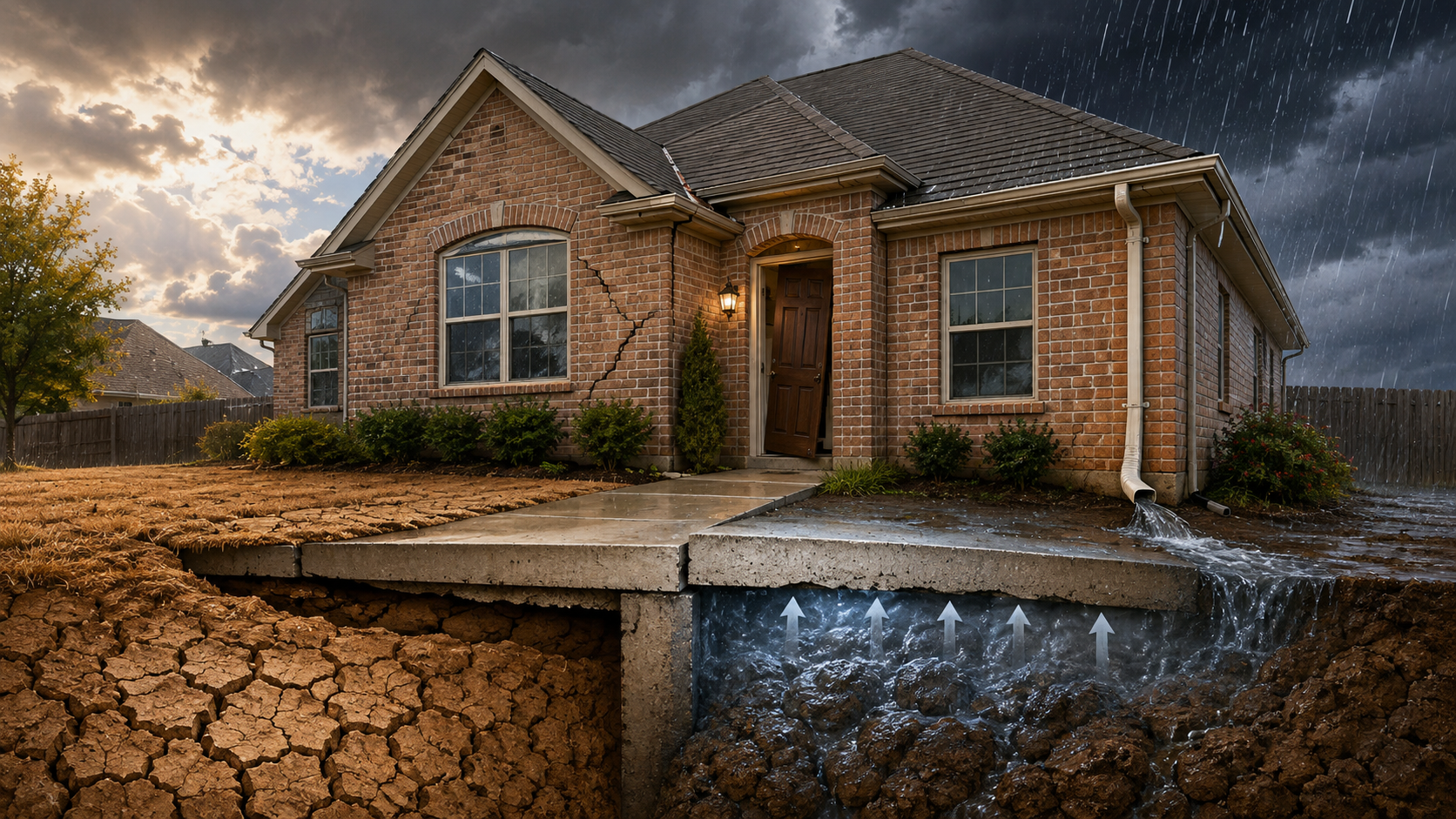


Why Foundation Problems Can Suddenly Appear After the First Fall Rain in North Texas
You made it through another North Texas summer. The lawn is exhausted, the ground is hard, cracks may have opened in the soil, and the dirt may even have pulled slightly away from the edge of your foundation. Then September or October finally delivers what everyone has been waiting for: rain.
A lot of homeowners naturally assume rain should make things better. For the yard, perhaps. For the soil supporting your house, the situation can be more complicated. After months of summer heat and dry weather, the soil around a North Texas home may have lost substantial moisture and contracted. When fall rain begins returning moisture to that soil, it starts changing again, and it does not necessarily change evenly.
That is why homeowners sometimes notice sticking doors, new drywall cracks, brick cracks, gaps around trim, or other apparent signs of movement shortly after the weather finally turns wetter. The rain did not necessarily break the foundation overnight. It may simply have changed the soil conditions enough for movement that developed gradually during the dry season to become noticeable.
For some homes, the issue is mainly moisture management or drainage. For others, the first fall rain reveals enough structural symptoms that a professional foundation evaluation makes sense. The important thing is figuring out which situation you have before guessing at the solution.
Why North Texas Soil Moves So Much
Much of the Dallas-Fort Worth area has clay-rich soil. Clay matters to foundations because its volume changes as its moisture content changes. When clay loses moisture, it contracts. When it absorbs moisture, it expands.
A house sitting above that soil therefore does not rest on something completely motionless. The soil beneath and around the foundation is continually responding to rainfall, heat, evaporation, drainage, landscaping, plumbing leaks, tree roots, and seasonal weather.
Some movement is normal. Problems become more concerning when movement is substantial or uneven.
Imagine the soil beneath one portion of a house remaining relatively moist while another becomes extremely dry. Those areas may not contract by the same amount. The same thing can happen when rain returns, because one area may absorb substantial water while another remains comparatively dry.
The issue is not simply whether the soil is wet or dry. It is how consistently moisture is distributed around and beneath the foundation.
What Happens to the Soil During a North Texas Summer?
By late summer, the soil around a DFW home may have spent weeks or months losing moisture. You can sometimes see the result without any equipment: hard baked ground, cracks in exposed soil, shrinking soil around landscaping, gaps between the soil and foundation, or soil that becomes difficult to penetrate with a screwdriver or similar probe.
A gap between the dirt and the foundation does not automatically mean the foundation is damaged. It does tell you the soil has contracted, and that is useful information because the same soil helps support the home.
Once the ground becomes extremely dry, the arrival of significant rain can create another substantial change in moisture conditions.
Then the Fall Rain Arrives
Rain begins rehydrating the soil from the surface downward. Clay that contracted during dry weather can begin expanding as it absorbs moisture, but the process is rarely uniform.
One side of the house may receive more sunlight while another remains shaded. A roof valley may discharge large quantities of water in one location. A driveway or patio may keep rainfall away from another. Trees may draw moisture from the ground, while poor grading or a badly placed downspout may allow water to collect beside one section of the foundation.
The result can be dramatically different moisture conditions around different portions of the same house. That is where differential movement becomes important.
What Is Differential Foundation Movement?
A foundation does not necessarily experience trouble because the entire house moves slightly upward or downward together. The more troublesome condition is when different portions move differently.
One area may settle while another remains relatively stable. One section of soil may expand faster after rainfall than another. The structure above that soil then has to accommodate those differences, and houses are not infinitely flexible.
Eventually, movement may become visible inside or outside the home.
Why Do Doors Suddenly Start Sticking After Rain?
A sticking door is one of the classic homeowner clues because doors depend on relatively precise geometry. If movement slightly changes the shape or position of an opening, the door may begin rubbing against the frame, refusing to latch, or opening differently than it did before.
That does not mean every sticky door indicates foundation trouble. Humidity can affect doors, hinges can sag, wood can move, and hardware can loosen. What becomes more interesting is a pattern.
If several doors begin sticking, windows become harder to operate, drywall cracks appear, gaps develop around trim, or exterior masonry begins cracking at the same time, the collection of symptoms deserves more attention. If you are seeing several of those changes together, Atlas can perform a free foundation evaluation to help determine whether the house is actually moving or whether you are dealing with something less serious.
Why Do Brick Cracks Sometimes Become More Visible in the Fall?
Brick veneer and mortar can make movement easier to see because masonry does not flex very much. Homeowners often become concerned about stair-step cracking that follows mortar joints between bricks, but the existence of a crack does not automatically tell you its cause or severity.
Homes develop cracks for many reasons, including normal settlement, thermal expansion, material shrinkage, construction details, and foundation movement. The useful question is not simply whether there is a crack. It is whether the crack is new, changing, widening, or appearing alongside other signs of movement.
Photographs can be helpful. If you notice a crack, photograph it periodically from the same position and include a ruler, coin, or another size reference. Memory is surprisingly bad at monitoring masonry. A dated photograph is much better.
What About Drywall Cracks?
Drywall is another place homeowners often first notice changes. Common locations include above doors and windows, around corners, near large openings, where walls meet ceilings, and along taped joints.
A tiny isolated drywall crack does not automatically announce structural trouble. Houses move slightly, building materials expand and contract, and drywall joints can crack. A new diagonal crack extending from the corner of a door or window becomes more interesting when it appears alongside other symptoms.
Again, patterns matter more than one mysterious line on the wall.
Can Heavy Rain Cause Foundation Problems?
Heavy rain can contribute to foundation movement, particularly when drainage allows water to accumulate unevenly around a house. But saying that rain simply causes foundation damage is too simplistic.
The real issue is usually the interaction between soil, moisture, drainage, and the foundation. Two houses can receive exactly the same storm while experiencing very different soil conditions.
At one house, gutters work properly, downspouts discharge away from the structure, the yard is graded appropriately, and water drains away. At another, a gutter overflows, a downspout empties beside the slab, and a low spot holds water against one corner of the house.
The rainfall total is identical. The foundation environment is not.
If water repeatedly pools beside part of your home, erodes soil, or pours from downspouts directly against the foundation, the issue may be drainage rather than the foundation itself. Atlas provides foundation drainage services to help manage water around the property before it becomes a larger problem.
Check Your Gutters Before the Fall Storms
Gutters are not glamorous foundation equipment, but they are part of your home’s water-management system. During a heavy storm, a roof collects a large amount of water, and the gutter system concentrates that water toward a relatively small number of discharge points.
If those discharge points work properly, water can be carried away from the foundation. If they do not, a significant amount of roof runoff can end up beside one relatively small portion of the house.
Before wetter fall weather settles in, check for clogged gutters, overflowing sections, disconnected downspouts, erosion beneath discharge points, water emptying directly beside the foundation, and low spots where runoff collects.
You do not need to become a civil engineer every time it rains. You do want water to have somewhere sensible to go.
Should You Stop Foundation Watering When Fall Begins?
Not necessarily just because the calendar changed. Foundation watering should respond to actual soil and weather conditions rather than the name of the month.
If North Texas remains hot and dry through September, the soil may still need moisture management. If substantial rain arrives, continuing to water exactly as though nothing happened makes little sense. The goal is not maximum watering. The goal is reasonably consistent soil moisture.
A dedicated foundation watering system can make that easier because it distributes water slowly around a much larger portion of the foundation perimeter than repeatedly moving a garden hose. Atlas’s Foundation Watering Program is designed for homeowners who want more consistent moisture management without turning foundation watering into another recurring household chore.
Why You Should Not “Catch Up” by Flooding Dry Soil
After noticing large cracks in dry ground, some homeowners understandably feel tempted to compensate aggressively. If the soil is extremely dry, give it an enormous amount of water and fix the problem immediately.
Not necessarily.
Rapidly saturating extremely dry soil is not the objective. Foundation moisture management works better as a matter of consistency. Dumping large amounts of water beside one portion of the foundation can create exactly the uneven moisture conditions you are trying to avoid, while slow application gives the soil time to absorb moisture more gradually.
Consistency beats enthusiasm. Your foundation does not need hydration revenge.
What Should You Inspect After the First Major Fall Rain?
A simple walk around the house can tell you quite a bit. Start outside and look at existing brick cracks, new masonry cracks, gaps around windows, separation around exterior trim, soil pulling away from the foundation, areas where water pools, erosion near downspouts, and standing water beside the house.
Then walk through the interior and pay attention to doors that suddenly rub or fail to latch, windows that have become difficult to open, new drywall cracks, trim separating from walls, unusual gaps, flooring changes, or noticeable slopes.
You are not trying to diagnose the foundation yourself. You are simply establishing whether anything has changed and whether those changes are occurring in a pattern.
When Should You Call Atlas?
A single hairline crack does not require panic. A professional evaluation becomes more sensible when you notice multiple signs of movement, substantial changes, or symptoms that continue worsening.
Examples include significant stair-step masonry cracking, several doors suddenly becoming misaligned, noticeably sloping floors, cracks that continue widening, separation around windows or exterior walls, visible movement between portions of the structure, or recurring symptoms that change with the seasons.
This is where a foundation evaluation is useful. Instead of trying to diagnose an entire house from one crack, Atlas can look at the pattern of symptoms and help determine whether you are dealing with normal seasonal movement, moisture or drainage issues, or a foundation problem that requires repair.
If several symptoms appeared after the first fall rain, book a free Atlas foundation evaluation rather than guessing at the cause.
Could the Problem Actually Be Plumbing?
Yes. Foundation movement and plumbing problems sometimes overlap.
A plumbing leak beneath a slab can introduce substantial moisture into soil that would otherwise be relatively dry, creating very different soil conditions beneath one part of the house. Foundation movement can also place stress on plumbing, which means the two problems can occasionally appear together.
This is why hydrostatic testing or another plumbing investigation may become relevant when foundation symptoms and possible under-slab leaks occur at the same time. Atlas also provides plumbing services when the evidence points below the slab rather than simply toward seasonal soil movement.
You do not want to spend money correcting the wrong problem.
Does Fall Rain Mean It Is Too Late for Foundation Maintenance?
No. Fall is actually an excellent time to examine what the summer revealed.
Dry weather can expose soil contraction, drainage shortcomings, gaps beside the foundation, and stressed landscaping. Then rainfall lets you see how water actually moves around the property. You can watch where roof runoff goes, where water collects, which downspout creates a miniature river, and which areas drain properly.
A rainy afternoon can provide a surprisingly good inspection of your home’s water-management system. You just have to look.
The First Fall Rain Is a Test, Not a Verdict
The transition from a dry North Texas summer into wetter fall weather places changing demands on the soil surrounding your foundation. That does not mean every September or October rainstorm is coming to damage the house.
It does mean seasonal changes can reveal movement that was difficult to see before. Pay attention to patterns, manage water rather than simply adding more of it, keep drainage working, and watch changes rather than panicking over every crack.
If your main concern is dry soil and maintaining more consistent moisture, learn about the Atlas Foundation Watering Program. If water is pooling or running toward the house, Atlas can help with drainage solutions. If you are seeing new cracks, sticking doors, uneven floors, or several signs of movement together, schedule a free foundation evaluation.
Sometimes the first good rain of autumn does more than rescue the lawn. It tells you where to look next.
Fall Foundation FAQs
Can rain make foundation cracks worse?
Changes in soil moisture can contribute to foundation movement, and existing cracks may become more noticeable as soil conditions change. Rain itself does not automatically mean a foundation is damaged.
Why did my door start sticking after heavy rain?
Soil around the foundation can expand as it absorbs moisture. If different portions of the house move differently, door openings may become slightly misaligned. Humidity, hinges, and ordinary door problems can also cause sticking.
Should I water my foundation during September and October?
Possibly. Foundation watering should depend on rainfall, temperature, soil moisture, drainage, and property conditions rather than the calendar alone. Reduce or stop watering when rainfall provides sufficient moisture.
Are cracks between the soil and foundation dangerous?
Not necessarily. They commonly occur when dry clay soil contracts. They indicate dry soil but do not by themselves prove structural foundation damage.
Should I fill foundation soil cracks with water?
Do not simply flood the cracks. Restore moisture gradually to the surrounding soil using slow, reasonably even watering.
What foundation problems should I look for after heavy rain?
Watch for new or changing brick cracks, drywall cracks, sticking doors, difficult windows, trim separation, drainage problems, erosion, standing water, or several symptoms occurring together.
Can bad drainage damage a foundation?
Poor drainage can create uneven soil moisture around a foundation and contribute to movement. Gutters, downspouts, grading, and other drainage systems should direct excess water appropriately away from the house.
When should I get my foundation inspected?
Consider an evaluation when cracks are substantial or worsening, several doors or windows become misaligned, floors appear uneven, multiple symptoms appear together, or you suspect significant foundation movement. Atlas offers free foundation evaluations for North Texas homeowners who want to know what is actually happening before deciding what to do next.